October 26, 2026 · 6-min read
How to Lead Prayer Time in Sunday School and Kids Church
Five quiet minutes, one repeatable routine, and a room full of kids who actually want to talk to God.
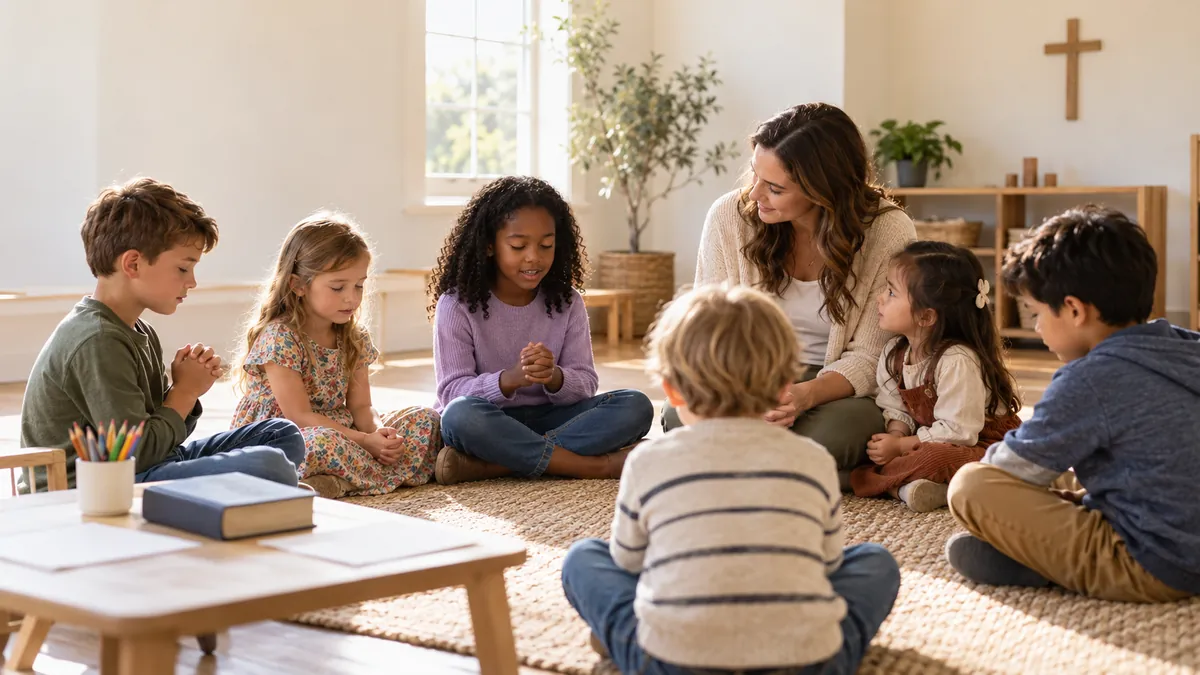
The simplest way to lead prayer time in kids church is to use the same short routine every week: gather, share one request, pray one sentence each, and close together. Five minutes is enough. A repeatable shape helps shy kids feel safe, helps wiggly kids know when it ends, and keeps long pray-ers within bounds.
You do not need to be a polished prayer leader. You need a plan and a gentle voice.
What does a simple prayer time look like?
Think of four small steps. You can run them in about five minutes.
- Gather. Bring kids into a circle or sit them at tables. Say, "It's prayer time. Let's get ready to talk to God."
- Share. Ask for one or two requests. Keep it light: "Who or what can we pray for this week?"
- Pray. Pray together using a simple pattern (more below).
- Close. End the same way every week, with a short line everyone knows.
Jesus said, "Let the little children come to me, and do not hinder them" (Matthew 19:14). Your job is mostly to clear the path.
How do I structure prayer in a mixed-age class?
Choose a format with more than one way to join in. That way a four-year-old and a ten-year-old can both take part without anyone feeling talked down to.
Here is a pattern that works well:
- Leader opens. You say a one-line welcome to God.
- Kids pray in short bursts. This is often called popcorn prayer. Kids "pop up" one at a time with a single sentence, like "Thank You for my dog" or "Please help my grandma feel better."
- Everyone repeats a closing line. For example, "Thank You, God, for hearing us. Amen."
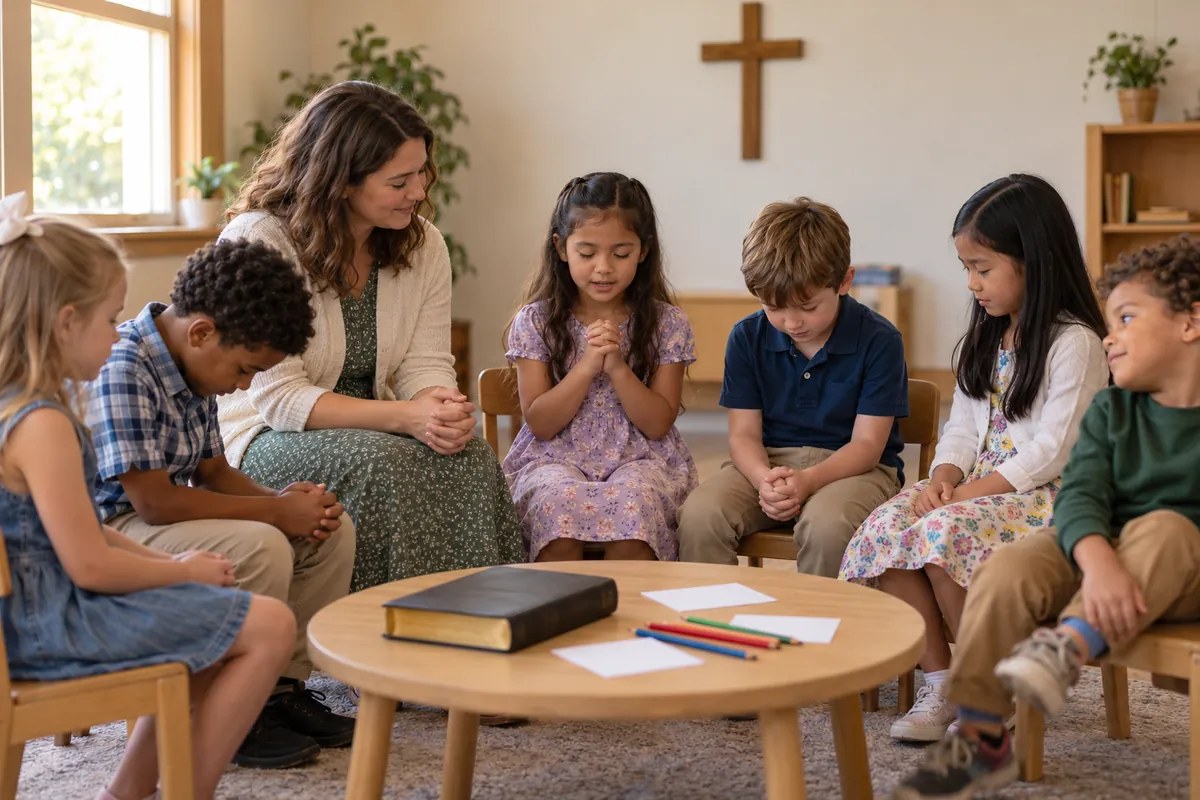
Younger kids can say one word or repeat after you. Older kids can pray a full sentence or take the lead on the closing. Pairing a preschooler with an older buddy also works well.
How do I help shy kids join in?
Make joining optional and low-pressure. A shy child who feels safe today often prays out loud next month.
Try these:
- Offer a pass. Say, "You can pray out loud, pray in your heart, or just say 'pass.' All of those are okay."
- Offer a whisper. Let a child whisper a request to you, then you pray it aloud.
- Give sentence starters. "God, thank You for ___." "God, please help ___."
- Use a prayer prompt card. A picture or word card gives a child something to hold and something to say.
- Never call on a child by surprise. Let kids volunteer or signal with a thumbs-up.
When a quiet child does pray, keep your response small and warm. A simple "Thank you for praying" is enough.
What do I do with wiggly kids during prayer?
Give their bodies a job. Most wiggling is energy, not disrespect. If you want more ideas on this, see what to do when a kid won't sit still during Bible time.
A few quick options:
- Let kids kneel, stand, or sit however they are comfortable, as long as they are safe and not distracting others.
- Use hand motions: open hands for thank-yous, folded hands for the closing.
- Hold something quiet, like a small stone or a paper cross.
- Keep prayer short. A tired room needs fewer words, not more.
Skip the "everybody freeze and close your eyes" demand. Invite instead of insisting.
How do I handle a child who prays for a very long time?
Set the frame before you start, then thank them kindly if they run over. Long pray-ers are usually sincere. They just need a boundary that does not feel like a rebuke.
- Before prayer: "Today we're doing one-sentence prayers so everyone gets a turn."
- During prayer: If a child keeps going, wait for a breath and say, "Thank you. God heard every word. Let's let a friend pray now."
- After class: Pull the child aside privately. "I love how much you love to pray. In class, let's keep it to a sentence or two, and you can pray the rest at home."
You can also give that child a special role, like "closing leader," so their enthusiasm has a good place to go.

What can I say to open and close prayer time?
Use the same words every week. Repetition gives kids confidence, and they will begin to say the lines with you.
Opening ideas:
- "God is listening. Let's talk to Him."
- "We can tell God anything. Who wants to share a request?"
Closing ideas:
- "Thank You, God, for hearing us. In Jesus' name, amen."
- A call and response: "God is near." "God hears our prayers."
If you need a fresh way to gather requests, how to write prayer requests kids will remember walks through simple options.
How do I keep it repeatable week after week?
Build a small routine and let the content change. The structure stays the same, while the requests, verses, and themes shift.
A quick checklist you can tape inside your lesson folder:
- Same spot, same circle or table
- One or two requests, not ten
- One-sentence popcorn prayers
- Same closing line
- Thank each child who prays, and each child who passes
Over time, this becomes a rhythm kids look forward to. For the bigger picture on how children learn to pray at different ages, see How to Teach Kids to Pray.
Is there a tool that makes this easier?
If you want something in kids' hands, a simple worksheet can give the structure a visual anchor. The Kids Popcorn Prayer Worksheet, Teach Prayer Activity, Sunday School Printable is a printable that walks kids through short, one-sentence prayers. It is handy for shy kids who like having words in front of them. You can also browse other classroom-friendly printables in the shop.
Whatever you use, keep it simple. A few honest sentences from a child, prayed in a calm room, are real prayer. You do not have to make it bigger than that.
Frequently asked questions
- How long should prayer time be in Sunday school?
- Three to five minutes is plenty for most mixed-age classes. Short and consistent beats long and occasional. Kids stay engaged when they know what is coming and when it ends.
- What if a child doesn't want to pray out loud?
- Let them pass, pray silently, or whisper their request to you so you can pray it for them. Praying out loud is something kids grow into. A safe room matters more than a full participation rate.
- How do I handle a child who prays for a very long time?
- Give the whole group a simple frame, like one sentence each, before you start. If a child still runs long, gently thank them and say 'God heard every word, and now it is a friend's turn.' Private encouragement afterward helps more than correction in front of the class.
- How do I include younger and older kids in the same prayer time?
- Use a structure with more than one way to join in. Little ones can repeat a short line or say one word, while older kids can pray a full sentence or lead a closing. Everyone takes part at their own level.
- Should kids be required to close their eyes when they pray?
- No. Scripture does not require it, and many kids focus better with eyes open or looking at a picture. Invite them to close their eyes if it helps, and keep the focus on talking to God.
- kids church
- sunday school
- group prayer
- prayer for kids
- children's ministry
- popcorn prayer
Related reading
- How to Explain the Trinity to Kids (Without Confusing Them)Learn how to explain the Trinity to kids with simple, accurate words and examples that avoid confusing analogies and stay close to Scripture.
- How to Teach Kids to Be a Good Friend (With Bible Verses)Bible verses about being a good friend for kids, plus simple ways to teach loyalty, kindness, and forgiveness at home or in Sunday school.
- Teaching Kids the Names of God: A Simple Starter ListA simple starter list of names of God for kids, with easy meanings and ways to teach each one at home or in Sunday school.