October 28, 2026 · 6-min read
Shy Kid Won't Pray Out Loud? Gentle Ways to Help Them Start
Your child loves Jesus, but the moment someone says 'Would you pray?', the words disappear. Here is how to help.
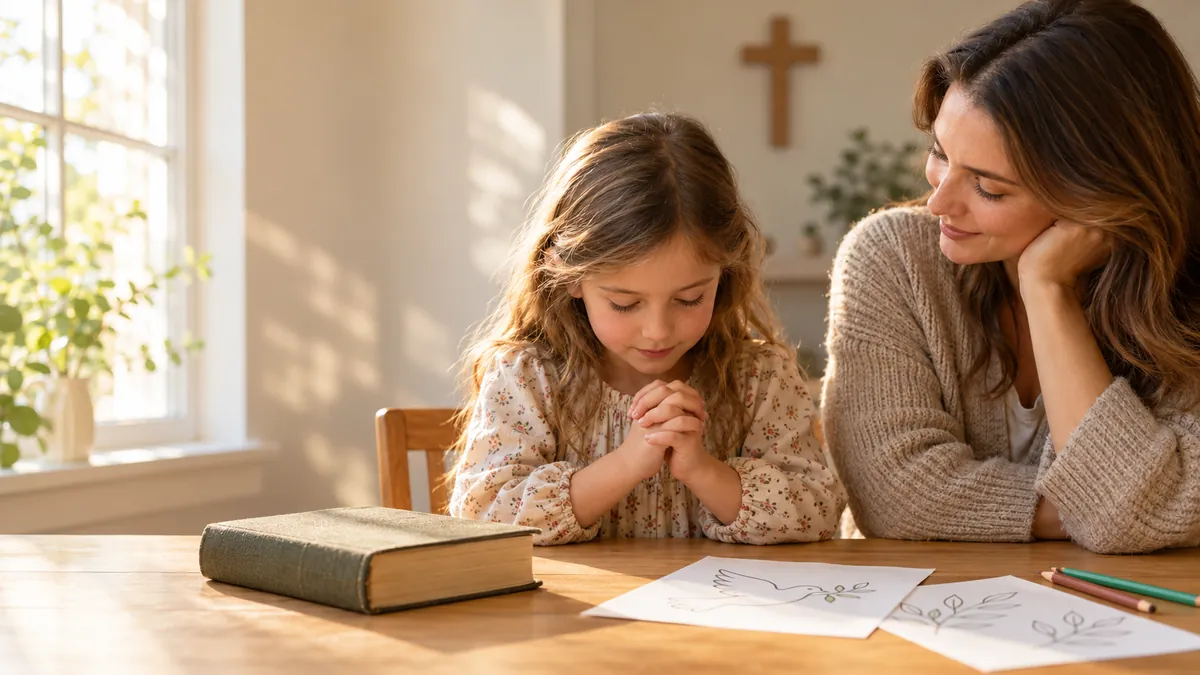
If your child is afraid to pray out loud, the best help is to remove the pressure and make prayer smaller, safer and more private at first. Start with silent, written or one-sentence prayers, and let confidence grow from there.
Freezing up does not mean your child's faith is weak. It usually means they care about getting it right. That is something you can work with.
Why is my child afraid to pray out loud?
Most shy kids are not afraid of God. They are afraid of people listening.
Common reasons include:
- Fear of saying the wrong words
- Worry about being judged or laughed at
- Feeling put on the spot in a group
- Believing prayers have to sound "grown-up"
- Naturally quiet or slow-to-warm-up temperament
Once you know which one it is, you can respond to the real problem. A child who fears an audience needs privacy. A child who fears wrong words needs simpler ones.
What does the Bible say about praying quietly?
Quite a lot, and it is good news for a shy child.
Jesus said, "When you pray, go into your room, close the door and pray to your Father, who is unseen" (Matthew 6:6). Private prayer is not second-best. It is exactly what Jesus described.
Psalm 139:4 says, "Before a word is on my tongue you, Lord, know it completely." And Romans 8:26 reminds us the Spirit helps us when we do not know what to pray.
Share one of these verses with your child. It tells them God is not grading their words.
How do I help my child start praying aloud?
Go slowly. Think of it as a staircase, not a leap. Let your child stay on each step as long as they need.
- Pray silently together. Sit side by side, close your eyes, and tell God one thing in your head. Say "Amen" together.
- Whisper. Let them whisper a prayer to you, or to God, with no one else nearby.
- Write or draw it. A note or a picture can be a real prayer. Read it quietly together.
- Use one sentence. "Thank You, God, for my dog." That counts.
- Pray with a parent. You say a line, they repeat it. Later, they add their own ending.
- Pray alone, aloud. Try this in a safe place, like the car or their bed, where no one is listening.
- Pray with a small group. Start with family, then a close friend or cousin.
Do not skip ahead because a step looks easy to you. Be patient, and let them tell you when they are ready.
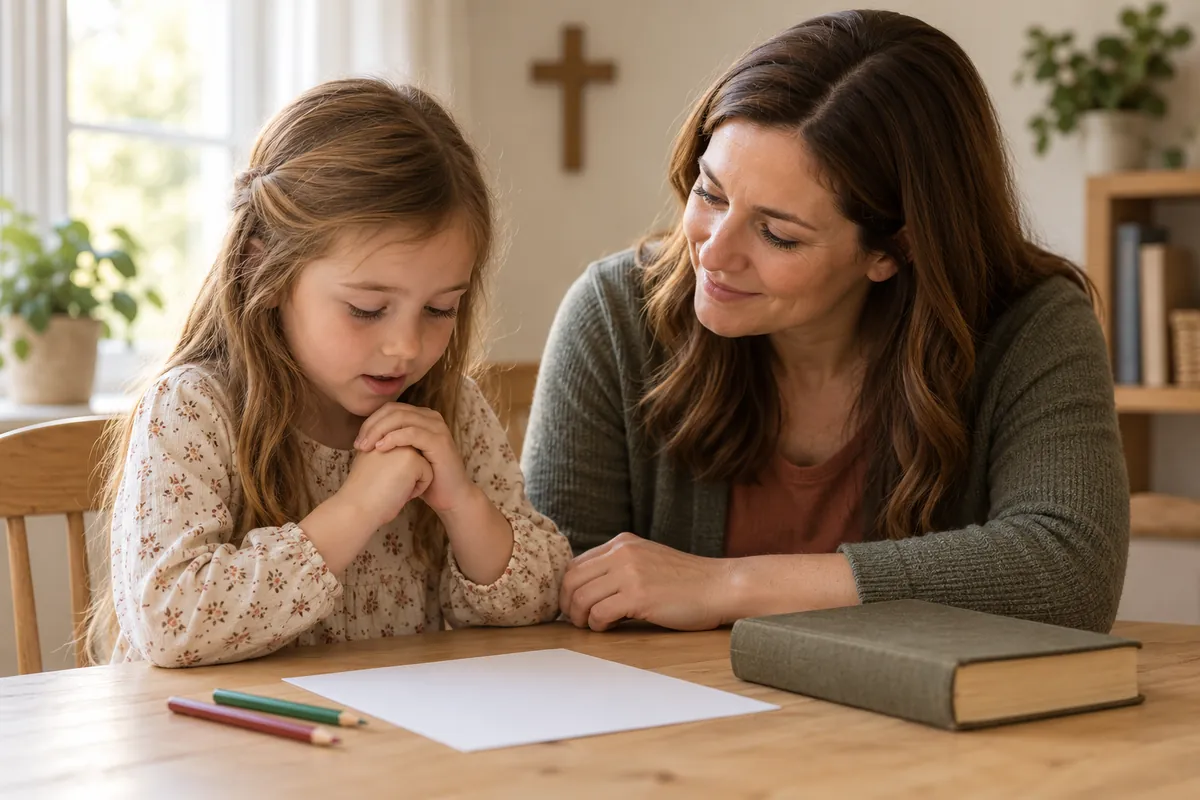
What can I say to a child who freezes?
Your words in the moment matter more than any technique. Keep them calm and short.
Try these:
- "You don't have to pray out loud. God hears you either way."
- "Want to pray in your head and squeeze my hand when you're done?"
- "I'll start, and you can finish with one word."
- "Would you like to pass today? That's okay."
Avoid these, even with good intentions:
- "Come on, it's easy."
- "Everyone else did it."
- "Don't be shy."
Being told not to be shy rarely helps. It tends to make a child feel more watched.
How can I make prayer feel safer at home?
Safety grows when prayer is ordinary and nobody is performing.
- Pray in low-stakes moments. Pray while driving, walking the dog or washing dishes. Short and casual removes the "big moment" feel.
- Go first and keep it simple. Let your child hear you pray plain, honest sentences, including awkward ones. "God, I'm tired today. Please help us." It shows them prayer is just talking.
- Never correct their words. Do not fix grammar or wording. If they say it, it is right.
- Thank them privately. Say "I loved hearing you pray" later, not in front of siblings.
- Skip the audience. Pray with one sibling or one parent at a time if group prayer feels like too much.
If worry is part of what holds your child back, you may find prayers for an anxious child a helpful companion. And if you are still building the habit, How to Teach Kids to Pray covers the basics age by age.
What if my child freezes in Sunday school or kids church?
Group prayer is the hardest setting for a shy child. A few small changes make it much kinder.
- Give a heads-up. Tell kids ahead of time: "In five minutes we'll pray. You can pray out loud, quietly or pass."
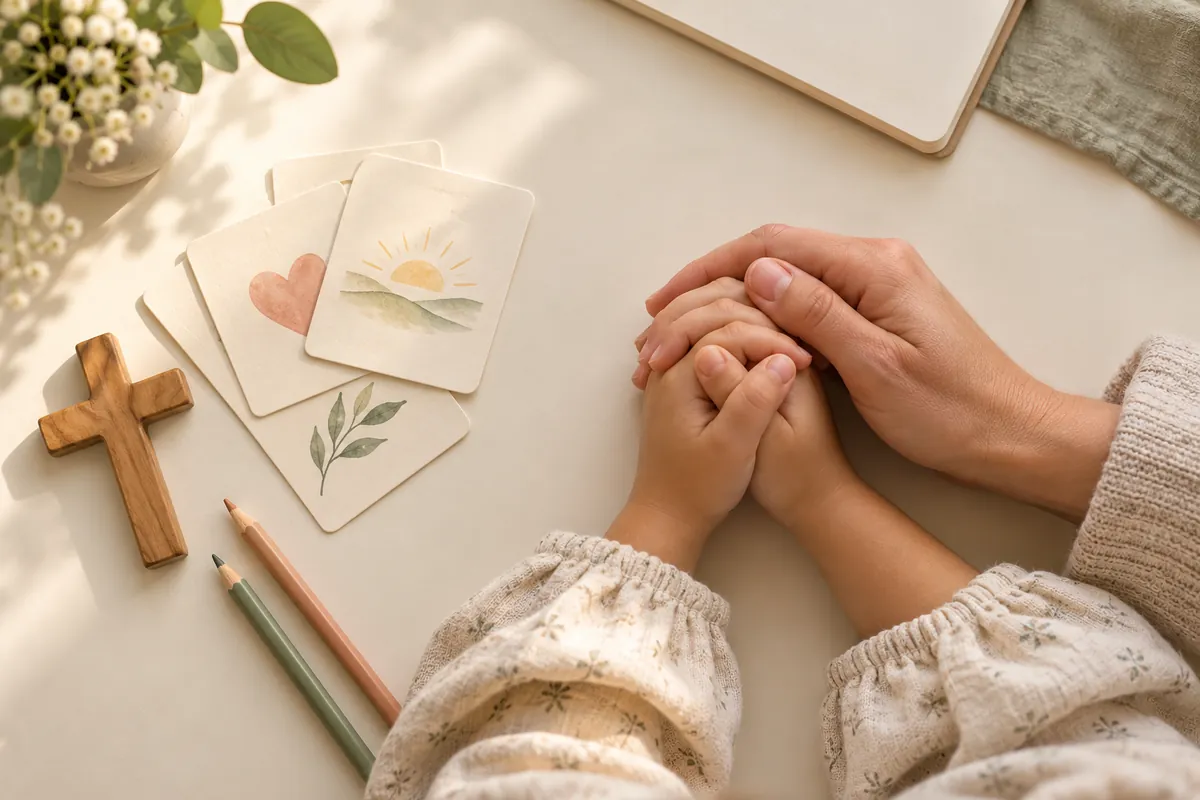
- Offer options, always. Out loud, silent, or pointing to a picture all count.
- Use short, repeatable prayers. "Thank You, God, for ___" is easy to complete.
- Pray in pairs or trios. Three kids feel like fewer eyes than twenty.
- Never go around the circle. A circle turns prayer into a test with a countdown.
For more on running this well, see how to lead prayer time in Sunday school and kids church.
Is it okay if my child never prays out loud?
Yes. It is okay to say that plainly.
Some children grow into quiet pray-ers. Their conversations with God happen in their heads, in a journal or on a walk. God is not less pleased with them.
Your goal is not a child who prays loudly. It is a child who knows God listens, and who feels free to talk to Him in whatever way fits. If they later find their voice, wonderful. If not, they still have a real prayer life.
What tools help a shy child pray?
Anything that gives them something to hold or point to takes pressure off their voice.
Ideas that work well:
- A short list of "things to thank God for" they can read from
- Prayer cards with a picture on each
- Sticky notes they place on a "prayer wall"
- A simple prayer pattern they can follow step by step
The popcorn style of prayer fits well here, because each person adds just a word or short phrase. If you want a ready-made option, the Kids Popcorn Prayer Worksheet gives kids a simple page to fill in and use. They can pray from it quietly, share a single line, or hand it to you. You can also browse other printables in the shop if you are looking for more.
What is one small step to try this week?
Pick one rung of the staircase and stay there for a few days.
Tonight, try this: sit next to your child, close your eyes and say, "Let's each tell God one thing, quietly." When you both finish, say "Amen" and smile. That is enough.
Courage in prayer usually grows slowly, in a place where a child feels safe. Be that place for them, and trust that God is already listening.
Frequently asked questions
- Is it normal for a child to be afraid to pray out loud?
- Yes, very. Many children, and plenty of adults, feel self-conscious praying in front of others. It usually reflects shyness or fear of saying it wrong, not a lack of faith.
- Do kids have to pray out loud for God to hear them?
- No. The Bible says God knows our words before we speak them, so silent prayers, whispered prayers and written prayers all reach Him. Praying aloud is one way to pray, not the only way.
- What can I do if my child freezes when asked to pray in Sunday school?
- Give them a quiet way out and a simple way in. Let them pass, pray a single sentence, or point to a picture or card instead. Warn them ahead of time so they are never caught off guard.
- At what age should a child be able to pray out loud?
- There is no set age. Some preschoolers pray freely while some teens stay quiet. Confidence tends to grow with safety and practice, so focus on comfort rather than a timeline.
- prayer for kids
- shy child
- praying out loud
- kids church
- family devotions
- sunday school
Related reading
- How to Explain the Trinity to Kids (Without Confusing Them)Learn how to explain the Trinity to kids with simple, accurate words and examples that avoid confusing analogies and stay close to Scripture.
- How to Teach Kids to Be a Good Friend (With Bible Verses)Bible verses about being a good friend for kids, plus simple ways to teach loyalty, kindness, and forgiveness at home or in Sunday school.
- Journey to Bethlehem: A Christmas Bible Map for KidsFollow the journey to Bethlehem in eight stops, from Nazareth to Egypt and home, with Bible verses and a simple family activity for each stop.