October 13, 2026 · 5-min read
Prayer Activities and Games for Kids: 10 Simple Ideas
Kids learn by doing. These hands-on prayer ideas turn 'I don't know what to say' into something they can see, hold and play.
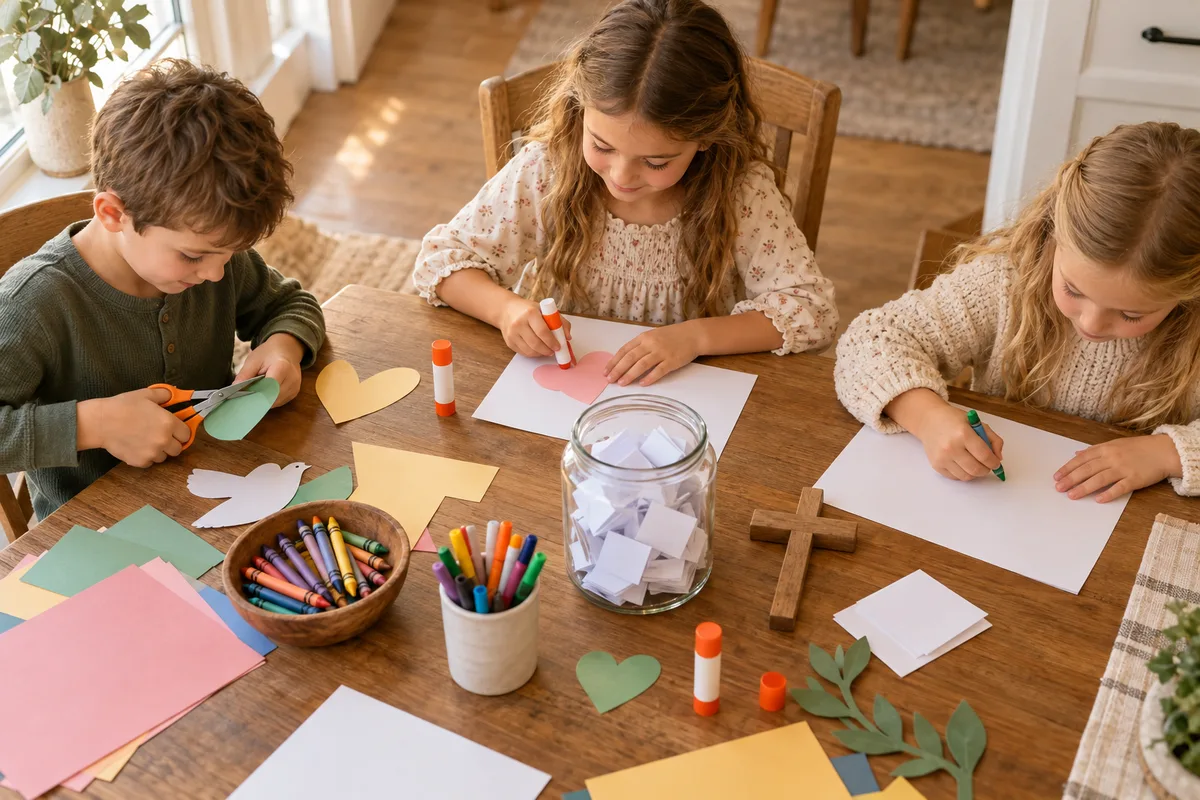
The best prayer activities for kids give them something to see, hold or do while they talk to God. A prayer jar, a five-finger prayer, a game of prayer catch or a simple prayer craft can turn "I don't know what to say" into a real, sincere prayer. Below are ten low-prep ideas for home, Sunday school or kids church.
Children learn by doing. When prayer is only ever "close your eyes and fold your hands," some kids drift off and others freeze. Hands-on activities don't replace that quiet kind of prayer. They give kids a way into it.
Why do hands-on prayer activities help kids pray?
A blank moment is hard for anyone. An activity hands a child a prompt (a name, a picture, a color) and the prayer follows naturally.
Activities also help different kinds of kids. The child who can't sit still can pray while walking. The artist can draw. The child who goes quiet in a group can write a prayer and put it in a jar. Jesus welcomed all of them: "Allow the little children, and don't forbid them to come to me" (Matthew 19:14).
The one rule: let the activity lead into prayer, not replace it. Every idea below ends with actually talking to God.
10 prayer activities and games for kids
1. The five-finger prayer
Hold up one hand. Each finger is a prompt: the thumb (closest to you) for family and friends, the pointer for teachers and church leaders, the tall middle finger for leaders in charge, the ring finger for people who are sick or sad, and the little finger for yourself. It's easy to remember, and kids always have their hands with them.
2. A prayer jar
Write names, worries and thank-yous on slips of paper and put them in a jar. At dinner or bedtime, each person pulls one out and prays for it. Add new slips whenever something comes up.
3. Prayer catch
Sit in a circle with a soft ball. Whoever catches it says a one-line prayer ("Thank You, God, for my dog") and throws it on. Children can pass if they're shy. Great for classrooms.
4. Popcorn prayers
Short prayers that "pop" up any time: in the car, before a game, when you see an ambulance. Kids learn that prayer isn't just for bedtime. A printable tracker like the Popcorn Prayers Worksheet lets them color a piece of popcorn each time they pray.
5. A prayer walk
Walk around your street, school or church and pray for what you see: the neighbors, the firefighters, the playground, the people inside the hospital. Moving kids often pray more freely than sitting ones.
6. A prayer chain
Each child writes or draws a prayer on a paper strip, then you link them into a chain. Hang it up and add a link for every new prayer. For extra meaning, add a gold link when a prayer is answered.

7. Prayer stations
Set up three or four spots around a room, each with a simple prompt: a bowl of water to say sorry (dip a finger, remember we're forgiven), a world map for praying for other countries, a basket of stones to "hand over" worries, a thank-you wall for sticky notes. Kids move between them at their own pace.
8. Snack-themed prayer crafts
Food themes make prayer instantly friendly for kids. A paper pizza where each slice is a different kind of prayer, an ice cream cone where every scoop is a prayer, a café menu where kids "order" a prayer. Our Prayer Snack Shop bundle has ten of these, and you can also get them one at a time: Prayer Pizza, Ice Cream Prayers and The Little Prayer Café.
9. Draw a prayer
Not every child wants to write or speak. Give them paper and crayons and ask them to draw who or what they want to pray for. Then let them tell God about the picture, out loud or silently.
10. A prayer for others
Choose one person each week: a missionary, a neighbor, a grandparent. Put their photo on the fridge and pray for them every day. Kids love to hear later how that person is doing. Here's how to write prayer requests kids will remember, so you can follow up together.
How to choose the right activity for your child
- Wigglers: prayer walks, prayer catch, popcorn prayers.
- Makers and artists: prayer chains, drawing prayers, snack-themed crafts.
- Quiet or shy kids: a prayer jar, drawing, writing in a prayer journal.
- Groups and classes: prayer catch, prayer stations, a class prayer chain.
Rotate them. A new activity every week or two keeps prayer fresh without making it a performance.
Keep the heart of it simple
Activities are a doorway. What you're really teaching is that God is close, He listens, and children can talk to Him about anything. The simple shape most of these use (thank You, sorry, please, and praying for others) is the same one explained in our ACTS prayer for kids guide.
For the bigger picture of building prayer at every age, see our guide to How to Teach Kids to Pray.
Frequently asked questions
- What are some fun prayer activities for kids?
- Popular ideas include a prayer jar of names to pray for, a five-finger prayer, a prayer walk around the neighborhood, prayer catch with a soft ball, and prayer crafts like a paper prayer chain. The best ones give children something to hold or do while they pray.
- How do you make prayer fun for kids without making it silly?
- Use play as the doorway, not the point. A game can help a child think of something to pray about, and then the prayer itself stays simple and sincere. Keep the tone warm, and end each activity with a real moment of talking to God.
- What prayer activities work in Sunday school?
- Prayer catch, a class prayer chain, prayer stations and a shared prayer wall all work well with groups. They keep everyone involved and give quieter children a way to pray without having to speak in front of the whole class.
- What age are these prayer activities for?
- Most of these ideas work from about age 4 to 12 with small changes. Younger children can draw or point instead of writing, and older kids can write longer prayers, lead the activity or keep a record of answered prayers.
- prayer
- kids prayer
- prayer activities
- sunday school
- kids church
Related reading
- How to Explain the Trinity to Kids (Without Confusing Them)Learn how to explain the Trinity to kids with simple, accurate words and examples that avoid confusing analogies and stay close to Scripture.
- How to Teach Kids to Be a Good Friend (With Bible Verses)Bible verses about being a good friend for kids, plus simple ways to teach loyalty, kindness, and forgiveness at home or in Sunday school.
- Teaching Kids the Names of God: A Simple Starter ListA simple starter list of names of God for kids, with easy meanings and ways to teach each one at home or in Sunday school.