August 17, 2026 · 6-min read
How to Explain Communion to Kids Without Overcomplicating It
Your child is watching the plate go by and asking questions. Here's how to answer them simply.
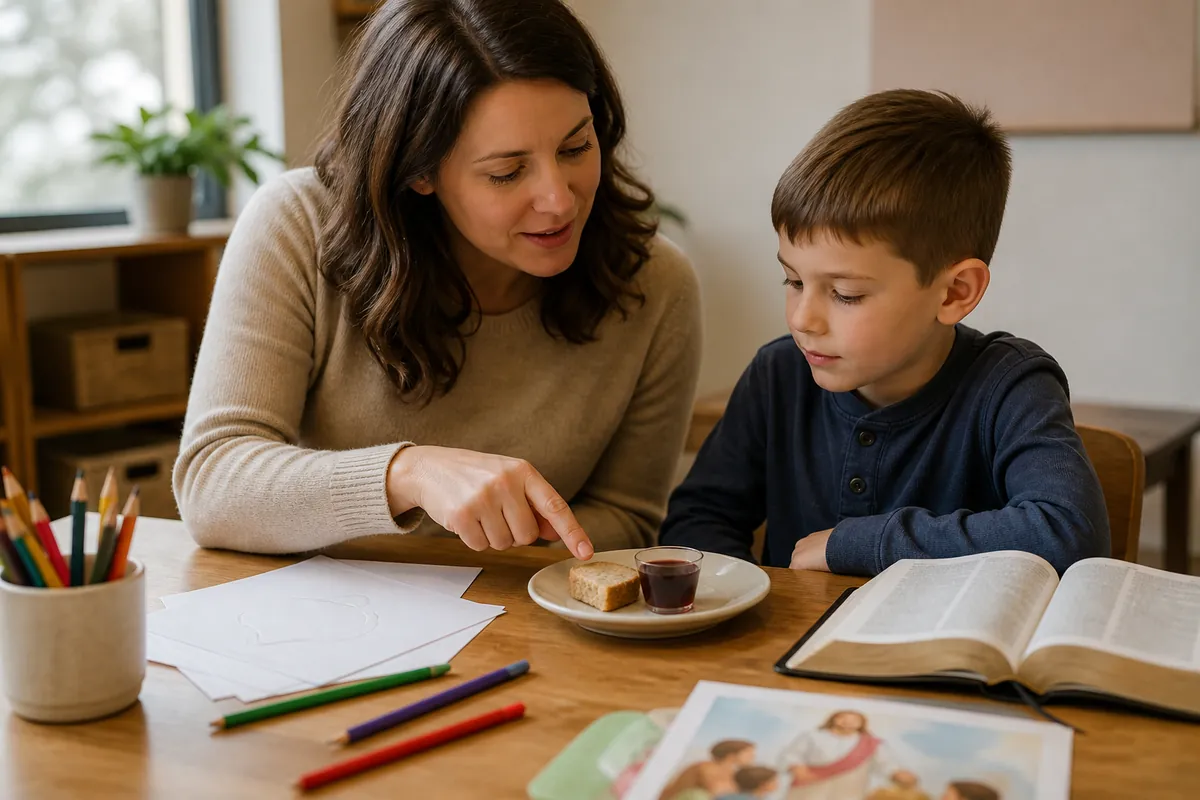
Communion is a simple, repeatable way Christians remember what Jesus did for us: he gave his body and shed his blood so our sins could be forgiven. You can explain that to a child using bread, juice, and one sentence: "We eat this to remember Jesus, and to say thank you."
That is really the whole idea. Everything else is just helping your child hold onto it.
What is communion, in kid-friendly words?
Kids do not need church history or denominational nuance. They need a picture they can hold onto.
Try something like this:
- "A long time ago, on the night before Jesus died, he had a special dinner with his friends."
- "He took bread and said, 'This is like my body, given for you.'"
- "He took a cup and said, 'This is like my blood, poured out for you.'"
- "He said, 'Do this to remember me.'"
- "So every time we take communion, we are doing what Jesus asked, remembering him and saying thank you."
That last line matters. Communion is not a test kids have to pass. It is a "we" activity, something the whole church family does together, on purpose, over and over.
Why do we eat bread and drink juice for this?
Kids often ask why food is involved at all. Here is a simple way to answer.
Bread and the cup are not magic and they are not just a snack. They are a picture. In the same way a photo helps you remember a person, the bread and juice help us remember what Jesus did.
You can say something like: "Jesus could have picked anything to help us remember him. He picked something we eat, because eating together is something families and friends already do. It is his way of saying, you belong at this table."
How do I explain this without scaring my child?
The cross is not an easy topic, and you do not need to soften it into something untrue. But you also do not need to give a young child more detail than they asked for.
A few guardrails that help:
- Answer the question your child actually asked, not the one you imagine they might ask next.
- It is fine to say Jesus died on the cross and it was very sad, and then move quickly to the good part, that he came back to life and communion is partly a celebration of that.
- If your child seems worried or confused, pause and ask what they are thinking, instead of adding more information.
- Keep your voice calm. Kids take their emotional cues from you more than from the words themselves.
If your child has bigger questions about dying, that usually deserves its own conversation. Our post on how to handle big questions about death with kids walks through that separately, so this conversation about communion can stay focused.

What should I say right before communion is served?
A short heads-up before the plate or tray comes by helps kids feel prepared instead of caught off guard. Something like this works in the car on the way to church or quietly in the pew:
- "In a few minutes, our church is going to take communion together."
- "That means people will eat a little bread and drink from a small cup."
- "We do this to remember that Jesus gave his life for us, and to say thank you."
- "If you are not taking it yet, that is okay. You can just watch, or come up for a blessing instead."
Giving your child a simple job, like watching quietly or folding their hands, can also help if wiggly hands are a struggle during a slower part of the service.
How do I know if my child is ready to take communion?
This varies by church, and by child, so it is worth talking with your pastor or children's ministry leader about what your congregation expects. As a general starting point, most parents and leaders look for a child to be able to say, in their own words:
- What communion is for
- Why Jesus died
- That they understand it is not just a snack
You do not need a perfect theological answer. You need honest evidence that your child has some real understanding, even if it is simple. A child who says "we do it to remember Jesus died for us and now we're saying thanks" has grasped the heart of it.
If your child is not there yet, that is not a failure. It is just information about what to keep talking through together.
What if my child asks a question I cannot answer?
This happens to every parent and every volunteer eventually. Communion tends to raise honest, hard questions, like why Jesus had to die, or what happens to the bread after we eat it.
It is always okay to say, "That is a really good question, and I want to think about it before I answer." That response teaches your child that questions are welcome, which matters more than having every answer ready on the spot. If this comes up often in your classroom or at your kitchen table, our post on how to handle a kid's question that stumps you in Bible class has some go-to phrases that take the pressure off.
A simple way to keep the conversation going
Communion does not have to be a one-time talk. A short follow-up question after church, like "what did we do today when we took communion, and why," helps the idea stick without turning into a lecture.
If you are looking for something low-pressure to keep in your bag or bin for quiet moments before or after the service, our printable Bible study notes for kids give children a simple way to draw or jot down what they are hearing, which can be a gentle way to revisit what communion means without more explaining from you. You can browse more ideas like it in the shop as well.
Communion will come up again and again as your child grows, and each conversation can go a little deeper. Starting simple now is not a shortcut. It is exactly the right place to begin.
Frequently asked questions
- At what age should a child take communion?
- There is no set biblical age. Many families wait until a child can explain in their own words what communion means and why we do it, which often happens somewhere between age five and ten. Your pastor or church leadership can tell you what your specific church practices.
- What if my child asks to take communion but I do not think they understand it yet?
- It is fine to say not yet, along with a reason your child can understand, like wanting them to know more about what it means first. You can also let them come forward for a blessing instead, so they still feel included.
- Is it okay to say communion is just a symbol?
- Churches differ on this, so it is worth checking what your own congregation teaches before you explain it to your child. In general terms, telling a child that the bread and juice help us remember Jesus is accurate and simple, without needing to settle deeper theological debates.
- Why do some churches use grape juice and others use wine?
- This is a practical church decision, not a biblical requirement, and different churches have different practices for good reasons, including serving children and those who do not drink alcohol. Follow whatever your own church uses.
- How often should we talk about communion at home, not just at church?
- A short conversation before your church takes communion, and a follow-up afterward asking what your child remembers, is usually enough. It does not need to be a big lesson every time.
- communion
- faith foundations
- sunday school
- family devotions
- kids church
Related reading
- How to Teach Kids to Read the Bible for ThemselvesLearn how to teach kids to read the Bible with simple, Scripture-first steps that build confidence and understanding.
- How to Teach Kids the Creation Story in 7 Simple DaysLearn how to teach kids the creation story with seven simple, Scripture-first lessons from Genesis 1 for home, class, or church.
- How to Teach Kids to Confess Sin Without Shaming ThemLearn how to teach kids about confession without shame using simple words, calm tone, and Scripture that points straight to forgiveness, not fear.