October 12, 2026 · 6-min read
Noah's Ark Sunday School Lesson: A Simple 30-Minute Plan
A Bible, a few sheets of paper, and a clear plan can help you lead with confidence.
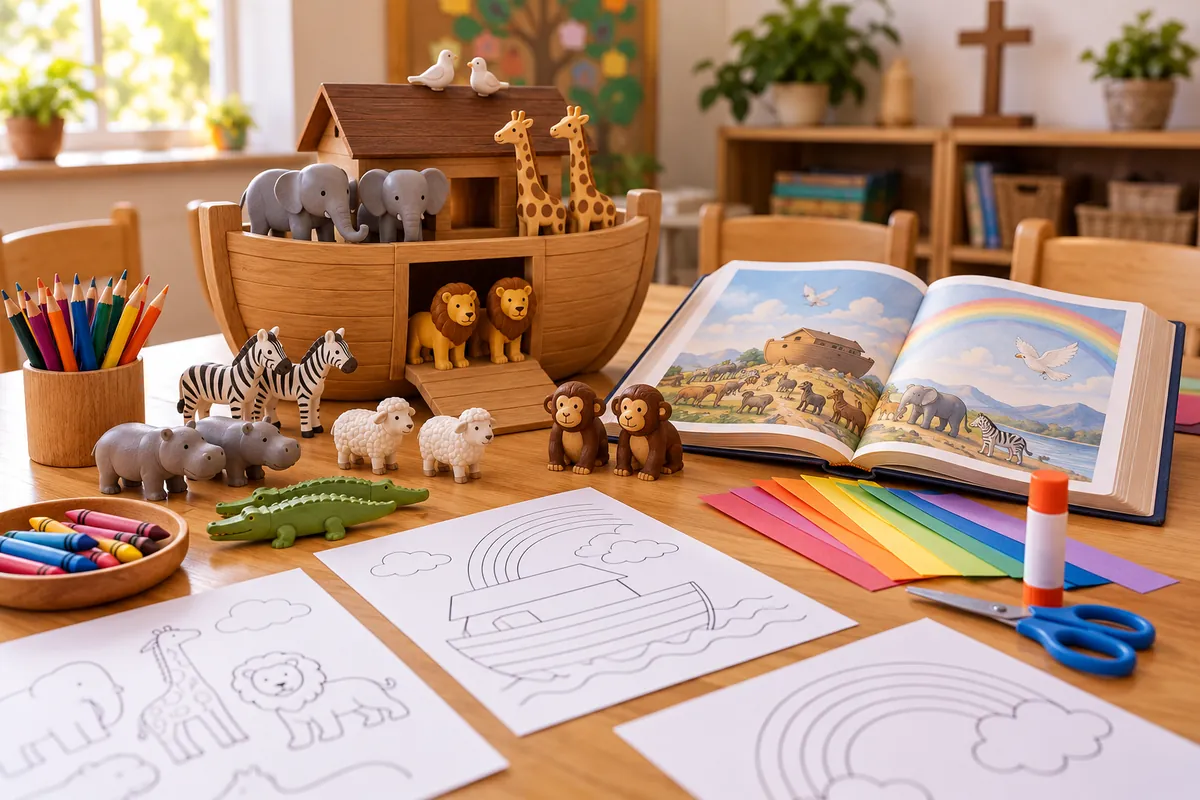
Teach this Noah's Ark Sunday school lesson in 30 minutes with a five-minute welcome, eight-minute Bible story, five-minute discussion, eight-minute activity, and four-minute prayer and review. Focus on one clear truth: God takes sin seriously, cares for His creation, and keeps His promises.
You do not need a model ark or a table full of craft supplies. This plan gives children ages 4–8 something to hear, something to talk about, and something to do.
What do you need for this Noah's Ark lesson?
Gather these supplies before children arrive:
- A Bible, with Genesis 6–9 marked
- One sheet of paper per child
- Crayons or washable markers
- Optional animal figures or animal picture cards
- Optional Noah’s Ark coloring pages or worksheets
Read Genesis 6:5–22, 7:1–24, 8:1–22, and 9:8–17 yourself beforehand. During class, read a few short passages aloud and summarize the rest.
Main truth: God is faithful, and we can trust His word.
Memory verse: Genesis 6:22. Read it from your classroom Bible, then explain that Noah did what God commanded him to do. Keep the wording consistent with the translation your church uses.
For a mixed-age group, invite older children to help younger ones find a passage or label a drawing. Children can participate by pointing or drawing if they are not ready to speak.
How do you teach Noah's Ark in 30 minutes?
Use this schedule as your ready-to-use lesson outline:
| Time | What to do | |---|---| | 0–5 minutes | Welcome children and introduce listening | | 5–13 minutes | Read and tell the Bible story | | 13–18 minutes | Ask three discussion questions | | 18–26 minutes | Make a three-part story picture | | 26–30 minutes | Review, practice the verse, and pray |
If conversation runs long, shorten the drawing time. Leave room for children’s questions without trying to cover every detail of the flood account.
Minutes 0–5: Practice listening
Invite children to follow three simple directions: touch their shoulders, place their hands in their laps, and cup a hand behind an ear. Seated movements work well, and children can watch if they prefer.
Then say:
“Today we’ll meet Noah. God gave Noah instructions for building an ark, a very large boat. Noah listened to God and did what He said.”
Ask, “What helps you listen when someone is giving instructions?” Accept a few answers, then open your Bible so children can see where the story comes from.
Minutes 5–13: Tell the Bible story
Read Genesis 6:11–14 and 6:22 aloud. Retell the story in these short sections:
- The world was full of wrongdoing and violence. God saw the harm people were doing. Noah found favor with God and walked with Him.
- God told Noah to build an ark. God gave him instructions, and Noah obeyed. Noah’s family and the animals entered the ark as God directed.
- The flood came. Rain fell for 40 days and nights. The flood brought terrible destruction, while God preserved those inside the ark.
- God remembered Noah. This means God continued to care for him and acted on his behalf. The waters gradually went down. Noah sent out birds, and later a dove returned with an olive leaf.
- God told them when to leave. Noah’s family came out after the earth had dried. Noah worshiped God, and God made a covenant—a firm promise—with Noah and every living creature.
Read Genesis 9:11–13 aloud. Explain that God promised never again to destroy all life with a flood. The rainbow was the sign of that covenant.
Keep the sequence clear: the rain stopped, but Noah still had to wait. He did not step out of the ark as soon as the clouds cleared.
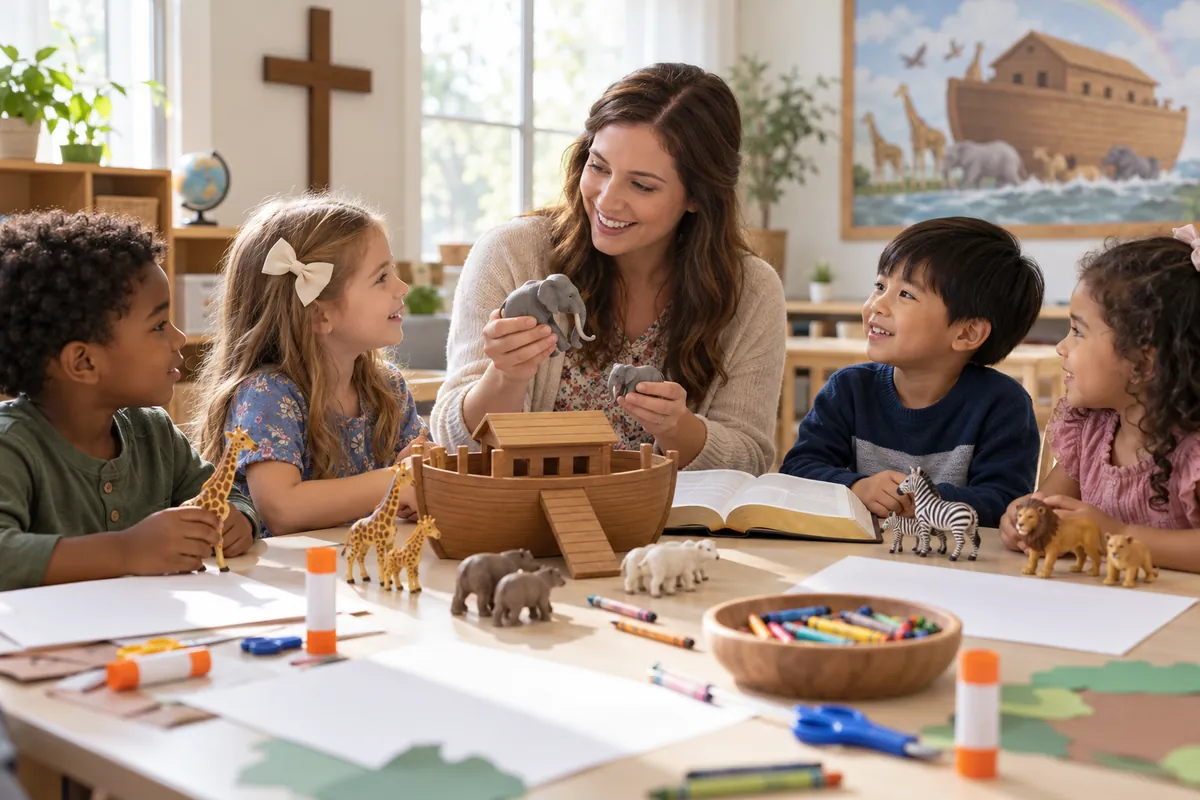
What questions help children understand the story?
Minutes 13–18: Talk about what happened
Start with questions children can answer from the story. Then make one gentle connection to daily life.
- What did Noah do when God told him to build the ark? He followed God’s instructions.
- What did God promise after the flood? Never again to destroy all life with a flood.
- What is one way we can practice something God teaches us? We can tell the truth, show kindness, or ask forgiveness when we hurt someone.
Give children a few quiet seconds to think. They do not need polished answers.
If someone says the rainbow means nothing bad will ever happen, gently clarify: “God’s promise was about this kind of flood. We still have hard days, and we can bring our worries to Him.”
Avoid turning Noah’s obedience into a promise that obedient children will never get hurt. The lesson points to God’s faithfulness, not a formula for an easy life.
What simple Noah's Ark activity can you use?
Minutes 18–26: Draw the story in three parts
Give each child a sheet of paper divided into three sections. Label them Listen, Wait, and Remember.
- Listen: Draw Noah building the ark. Ask, “Whose instructions did Noah follow?”
- Wait: Draw the ark on the water or the dove returning. Ask, “Did Noah leave as soon as the rain stopped?”
- Remember: Draw a rainbow. Ask, “What promise does this remind us of?”
Let younger children draw one picture while you write their explanation underneath. Older children can add a sentence and the reference Genesis 9:11–13.
The drawings do not need to look a certain way. Use the activity to hear what children understood.
If supplies are limited, make one shared picture and let children suggest details. For another low-prep teaching approach, see how to do a Bible object lesson with kitchen items.
How do you explain the flood without frightening kids?
Be truthful without describing suffering in graphic detail. Genesis connects the flood with human wickedness and violence; the serious part of the account should not disappear behind the animals.
You might say:
“People were hurting one another, and God judged that evil through the flood. Many people and animals died. That is a sad, serious part of this story. God preserved Noah, his family, and the animals with them.”
Do not use the flood to threaten children about ordinary mistakes. If a child asks a difficult question, listen before answering. It is fine to say, “That’s a hard question. Let’s look at what the Bible tells us.”
For children who have experienced flooding, acknowledge that this story may bring up worries. Do not present a recent disaster as God’s punishment for particular people.
How should you finish the lesson?
Minutes 26–30: Review and pray
Point to the three activity pictures and ask children to finish these sentences:
- “God told Noah to build an…”
- “Noah waited until God told him to…”
- “The rainbow was a sign of God’s…”
Read Genesis 6:22 again and invite children to repeat it in short phrases.
Close with a simple prayer:
“God, thank You for keeping Your promises. Help us listen to Your word and do what You teach us. Help us bring our questions and worries to You. Amen.”
If having pages prepared would make your next class easier, the Noah’s Ark Activity Pack for Kids is a printable option to consider alongside this lesson. The plain-paper activity works well too.
Send children home with their pictures and one family discussion prompt: “What promise did God make after Noah left the ark?” That gives parents an easy way to reopen the Bible story together.
Frequently asked questions
- What age group is a Noah's Ark lesson suitable for?
- This lesson is designed for ages 4–8. Preschoolers can listen to a shorter retelling and draw, while older children can read the passages and discuss God's covenant.
- Did Noah take only two of every animal?
- Genesis 6:19–20 describes bringing animals in pairs. Genesis 7:2–3 gives additional instructions for seven pairs of clean animals and birds, so the familiar two-by-two summary leaves out part of the account.
- Was Noah in the ark for only 40 days?
- No. Rain fell for 40 days and nights, but Noah and his family stayed in the ark much longer while the floodwaters receded and the earth dried.
- Can I teach this lesson without a printer?
- Yes. Use a Bible, plain paper, and crayons for the whole lesson. Children can draw the story in three parts instead of using a worksheet.
- sunday school
- noahs ark
- bible activities
- kids ministry
- bible lessons
Related reading
- How to Lead a Kids Bible Study Journal Without Winging ItLearn how to use a Bible journal with kids in five simple, repeatable steps, so journal time becomes a habit instead of a guessing game.
- How to Teach Kids to Read the Bible for ThemselvesLearn how to teach kids to read the Bible with simple, Scripture-first steps that build confidence and understanding.
- How to Teach Kids the Creation Story in 7 Simple DaysLearn how to teach kids the creation story with seven simple, Scripture-first lessons from Genesis 1 for home, class, or church.