September 7, 2026 · 6-min read
How to Teach Kids to Confess Sin Without Shaming Them
Confession doesn't have to end in tears and a lecture. Here's how to help kids own their mistakes and meet God's forgiveness at the same time.
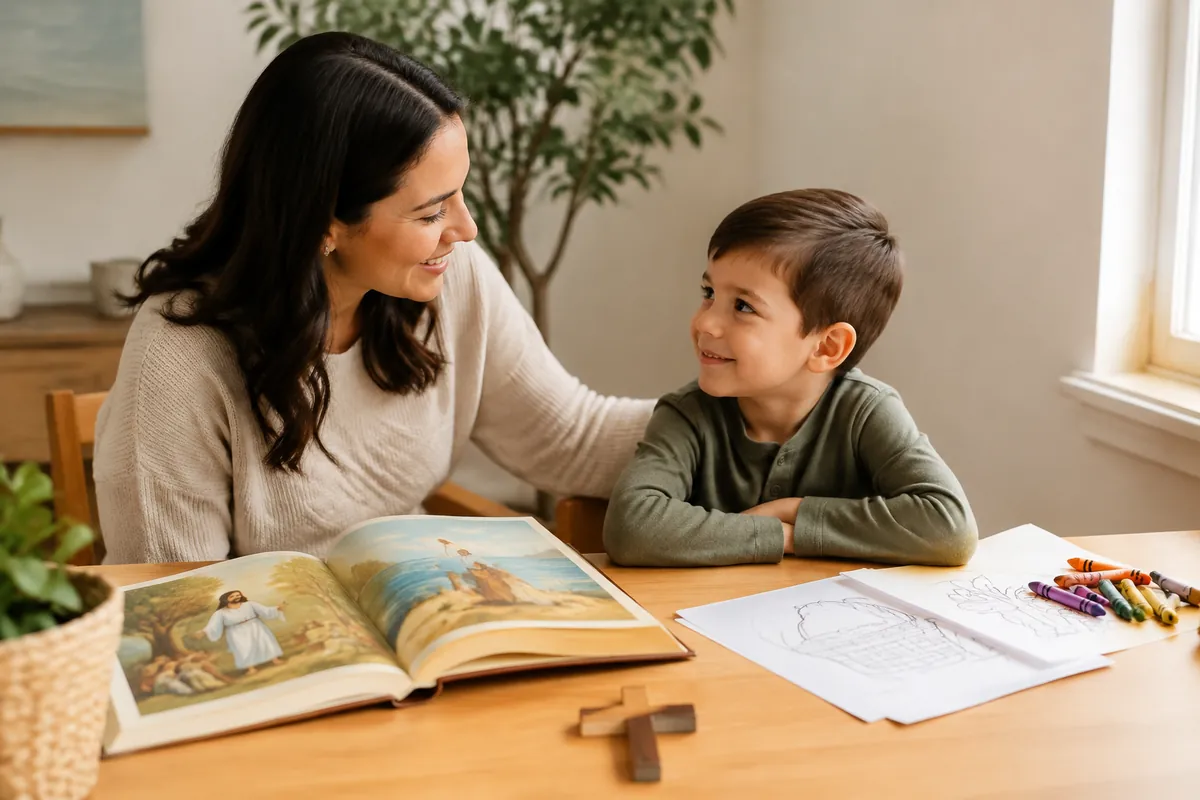
Teach kids about confession without shame by separating the sin from the child's identity, keeping your tone calm and curious instead of angry, and pairing every confession with a clear, immediate word of forgiveness. The goal is a child who feels safe admitting wrong, not one who hides it to avoid feeling small.
That distinction matters more than it sounds. Shame tells a child "you are bad." Conviction tells a child "you did something that isn't like you, and it can be made right." Kids can't tell the difference on their own. We have to show them.
What's the difference between shame and conviction?
Shame says something is wrong with who the child is. Conviction says something is wrong with what the child did. That's the whole hinge point.
A child who feels shame usually does one of two things: lies to avoid it, or shuts down and stops trying. A child who feels conviction tends to come clean, because coming clean doesn't cost them their sense of being loved.
You can hear the difference in your own words:
- Shame-based: "What is wrong with you? Why would you do that?"
- Conviction-based: "That's not okay, and it's not like you. What happened?"
Both address the same behavior. Only one leaves the door open.
Why do kids hide mistakes instead of confessing?
Kids hide things for the same reason adults do: fear of the reaction. If confession has historically meant yelling, punishment out of proportion, or a parent's disappointed silence, a child learns fast that hiding is safer than telling.
This isn't about being permissive. Consequences still matter. But the emotional tone around confession teaches kids far more than the consequence itself does. A calm "thank you for telling me" after a hard confession does more discipleship work than most lectures ever will.

How do I explain confession to a young child?
Keep it concrete and short. Young kids think in pictures and actions, not abstractions, so skip theological language and use everyday words.
Try something like this:
- "Confession just means telling the truth about something we did wrong."
- "When we confess to God, He already knows — we're not surprising Him, we're just being honest."
- "God promises to forgive us every single time we're honest with Him."
That last point does the heavy lifting. Kids need to hear the promise before they're asked to do the hard thing. Scripture backs this up plainly: "If we confess our sins, he is faithful and just to forgive us our sins, and to cleanse us from all unrighteousness" (1 John 1:9). The forgiveness isn't in question. That's what makes confession safe.
What should I say in the moment it happens?
When you catch a mistake, or a child comes to you with one, your first sentence sets the emotional tone for everything after it. A few phrases that keep the door open:
- "Thank you for telling me. That was brave."
- "It sounds like something happened. Want to tell me about it?"
- "You made a mistake. That doesn't change how much I love you."
- "What do you think we should do to make this right?"
Avoid comparisons ("your sister would never do this"), labels ("you're such a liar"), and rhetorical questions meant to shame ("how could you?"). None of those help a child move toward honesty next time.
How can Bible stories help kids understand confession?
Stories make abstract ideas land. A few that work well with kids:
- David and Nathan (2 Samuel 12) — shows a grown man confessing and being restored, not destroyed.
- The Prodigal Son (Luke 15) — shows a father running toward a child who expected rejection.
- Zacchaeus (Luke 19) — shows confession leading to joy and change, not just punishment.
Each story pairs wrongdoing with restoration. That pairing is the whole point. If you tell the story and stop at the wrongdoing, you've only told half of it.
Proverbs puts the principle plainly too: "Whoever conceals their sins does not prosper, but the one who confesses and renounces them finds mercy" (Proverbs 28:13). Kids can understand mercy long before they can define theology.

How do I model confession as a parent or teacher?
Kids watch what adults do with their own mistakes far more closely than they listen to what adults say about theirs. If you snap at your child and never acknowledge it, you're teaching that confession is only for kids.
A simple model to follow out loud, in front of them:
- Name what you did: "I raised my voice at you, and that wasn't fair."
- Don't over-explain or excuse it away.
- Ask for forgiveness directly: "Will you forgive me?"
- Move on without dwelling on it further.
This is often more formative than any planned lesson. It shows confession as a normal part of a healthy relationship with God and others, not a special punishment reserved for children.
Family devotion time is a natural place to build this rhythm — if you're not sure where to start, our guide to starting family devotions walks through a simple, low-pressure structure. And if lecture-style teaching tends to lose your kids' attention on topics like this, teaching the fruits of the Spirit without a lecture has approaches that transfer well here too.
What words should I avoid using?
A short list worth keeping in mind:
- "What's wrong with you?"
- "You always do this."
- "I'm so disappointed in you."
- "Just say sorry so we can move on."
Each one either attacks identity or rushes past the honesty step. None of them teach a child to bring their next mistake into the light.
If you're looking for something hands-on to reinforce this at home or in class, our Kids Prayer Worksheet, Christian Homeschool Activity, Sunday School Lesson gives kids simple, guided language for talking to God honestly — including space to name a mistake and a prayer of thanks for forgiveness. It's a small, low-pressure way to practice the habit outside of a hard moment. You can browse more printables like it in the shop.
Confession, taught this way, stops being something kids dread and starts being something they trust. That's the whole goal — not perfect kids, but kids who know where to bring their mistakes.
Frequently asked questions
- What age can kids understand confession?
- Most kids grasp the basic idea by age four or five, once they understand right from wrong and can name a feeling. Keep the language concrete at that age and add nuance as they grow.
- Is it wrong to make a child say sorry?
- Asking a child to say sorry is not wrong, but it should follow understanding, not replace it. A rushed sorry without reflection teaches performance instead of confession.
- How is confession different from just getting in trouble?
- Getting in trouble focuses on consequences from a parent or teacher. Confession is a child choosing to name what they did wrong and turn toward God and others, which can happen alongside consequences, not instead of them.
- What if my child confesses the same sin over and over?
- That is normal, not a sign confession is not working. Keep responding with the same calm, forgiving pattern each time. Repetition is part of how young hearts learn a habit sticks.
- Should confession happen publicly in kids church?
- Public confession is not necessary or appropriate for most children. Keep individual confessions private and one-on-one, and save group time for general prayers of confession the whole class says together.
- confession
- kids church
- family devotions
- christian parenting
- sunday school
- forgiveness
Related reading
- How to Teach Kids to Read the Bible for ThemselvesLearn how to teach kids to read the Bible with simple, Scripture-first steps that build confidence and understanding.
- How to Teach Kids the Creation Story in 7 Simple DaysLearn how to teach kids the creation story with seven simple, Scripture-first lessons from Genesis 1 for home, class, or church.
- How to Teach Kids the Ten Commandments (Without a Boring List)A simple, Scripture-first way to teach kids the Ten Commandments through stories, actions, and everyday choices instead of memorization.